 Industry Insights
How Small Teams Compete with Big Brands Using AI Tools
The production quality gap is closing -- and small teams are winning on agility, authenticity, and AI-powered efficiency
The Playing Field Has Changed
For most of social media's history, large brands held structural advantages that small teams simply could not overcome. Big brands had production studios, creative agencies, dedicated social media managers, professional video editors, and advertising budgets that dwarfed what a small team could assemble. The result was a content quality gap that was visible in every feed -- polished brand content sat alongside scrappier small-team efforts, and the difference was obvious.
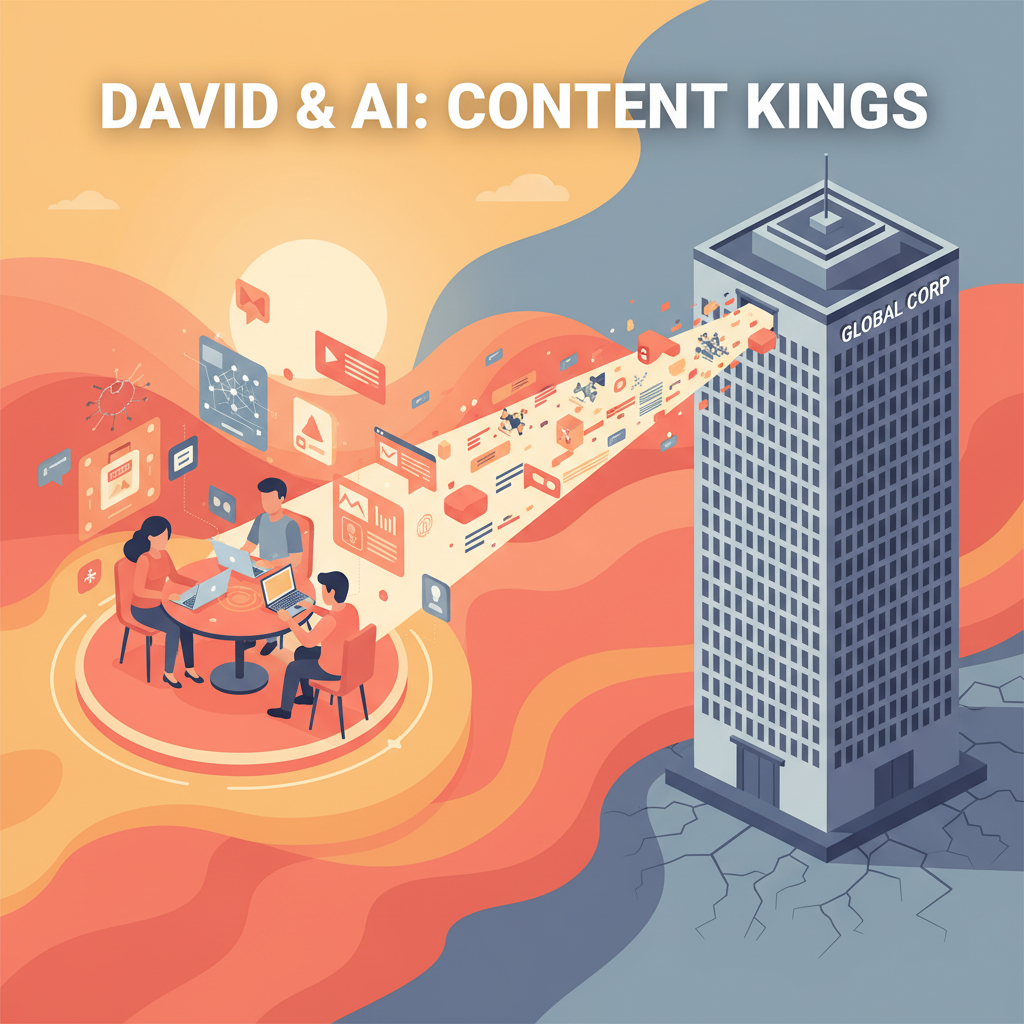
In 2026, that gap has narrowed dramatically. The combination of AI content generation, automation tools, and accessible distribution platforms has created conditions where a three-person team can produce content at a volume and quality level that rivals what large brands achieve with 20-person departments and agency retainers.
This is not a theoretical possibility. It is happening across industries, and the small teams that are leveraging these tools effectively are growing faster than many of their larger competitors.
The AI Equalizer: Production Quality
The most visible advantage large brands once held was production quality. Professional photography, studio-quality video, custom graphic design, and polished copywriting required either in-house specialists or agency partnerships -- both of which are expensive.
What AI Generation Has Changed
AI content generation tools have made professional-quality production accessible at a fraction of the traditional cost:
- Video generation: AI models can produce short-form video content from text prompts or still images, eliminating the need for cameras, lighting, and studios for certain content types
- Image generation: Product mockups, lifestyle imagery, social media graphics, and promotional visuals can be generated in minutes rather than hours
- Audio production: Background music, voiceovers, and sound design can be created without hiring audio professionals or licensing expensive stock libraries
- Copywriting: AI language models produce captions, scripts, blog posts, and ad copy that matches or exceeds the quality of junior copywriters
The key insight is not that AI replaces all human creativity -- it does not. The insight is that AI handles the production-heavy tasks that previously required specialized skills or equipment, freeing small teams to focus on strategy, authenticity, and audience connection where they actually have an advantage.
Quality Parity in Practice
Consider the production requirements for a typical brand social media post:
| Element | Traditional Approach | AI-Powered Approach |
|---|---|---|
| Product photography | Professional photographer ($500-2,000/shoot) | AI image generation ($0.05-0.50/image) |
| Video production | Videographer + editor ($1,000-5,000/video) | AI video generation ($0.10-2.00/video) |
| Graphic design | Designer ($50-150/hour) | AI image generation + templates ($0.05-0.50) |
| Copywriting | Copywriter ($100-500/post) | AI chat models ($0.01-0.10/post) |
| Background music | Licensed stock ($15-100/track) | AI audio generation ($0.05-0.50/track) |
The cost differential is not 10% or even 50%. It is often 90-99% lower for AI-generated content. This does not mean AI output is always a perfect substitute -- there are contexts where human-produced content remains superior. But for the volume of content that social media demands, AI-generated assets reach a quality threshold that audiences accept and engage with.
Content Volume: The Consistency Advantage
Social media algorithms reward consistency. Creators and brands that post daily (or multiple times daily) receive preferential algorithmic treatment compared to those posting weekly or sporadically. Large brands have historically met this demand by throwing resources at the problem -- more people producing more content on a fixed schedule.
Small teams with AI tools can now match this cadence without matching the headcount.
The Math of AI-Powered Content Production
A small team using AI tools can realistically produce:
- 5-10 short-form videos per day using text-to-video and image-to-video AI models
- 10-20 static image posts per day using AI image generation
- 20-30 captions, threads, and text posts per day using AI chat models
- Custom audio tracks for every video without stock licensing constraints
Compare this to a traditional setup where a single video editor might produce 2-3 polished videos per week, or a graphic designer might create 5-10 social graphics per day. The AI-powered small team achieves comparable weekly output to a department of 5-10 specialists.
Quality at Scale
Volume alone is not sufficient -- the content needs to maintain quality standards. AI tools support quality at scale through:
- Template systems: establishing visual and tonal consistency that applies across all generated content
- Iterative refinement: using AI chat models to workshop captions and scripts before publishing
- A/B variation: generating multiple versions of content to test what resonates
- Brand voice training: providing examples to AI models that help maintain consistent tone across high volumes of output
Distribution: Replacing the Social Media Manager
Large brands typically employ one or more dedicated social media managers whose primary job is distribution: scheduling posts, uploading content to each platform, managing platform-specific settings, responding to comments, and monitoring analytics. This is a full-time role that a small team often cannot afford to staff.
Automation tools have effectively replaced the distribution function of this role.
What Automation Handles
Modern social media automation platforms handle the mechanics of distribution:
- Multi-platform publishing: posting the same or adapted content to 10+ platforms from a single interface
- Scheduling: queuing content days or weeks in advance, timed for optimal engagement windows on each platform
- Platform-specific formatting: automatically adapting aspect ratios, caption lengths, and metadata for each network
- Analytics aggregation: pulling performance data from all platforms into a single dashboard
What remains for the human team is the strategic layer: deciding what to post, when to engage directly with the audience, and how to adjust the content strategy based on performance data. These are the high-value decisions that small teams are often better positioned to make than large organizations, because the decision-makers are closer to the audience and can act faster.
SwapFlow's Workspace Features for Small Teams
SwapFlow's Business plan is specifically designed for the small team use case, providing:
Team Collaboration
- Up to 25 team members on the Business plan at $49/month
- Workspace-based organization: all team members access shared content, schedules, and analytics
- Role-based access: team leads can manage permissions and workflows
- Shared API key management: the team uses a single pool of AI generation credits, simplifying billing and allocation
AI Model Access
SwapFlow provides access to over 70 AI models spanning:
- Video generation: text-to-video, image-to-video, video-to-video transformation
- Image generation: text-to-image, image-to-image editing, style transfer
- Audio generation: music, voiceovers, sound effects
- Text generation: chat models for scripting, captioning, and ideation (Claude Opus 4.5, Gemini Pro, Claude Sonnet 4.5, Gemini Flash)
These models are accessible without enterprise contracts, minimum commitments, or separate subscriptions. A small team gets the same AI capabilities that a large brand would access through an expensive enterprise agreement.
Multi-Platform Publishing
All 11 supported platforms (Twitter/X, Instagram, Facebook, LinkedIn, TikTok, Threads, Telegram, Snapchat, Pinterest, Bluesky, YouTube) are available from the same workspace. Team members can:
- Compose and schedule content for all platforms
- Manage platform-specific settings (TikTok AIGC labels, YouTube Shorts vs. long-form, Pinterest Board selection)
- Review and approve content before publication
- Monitor cross-platform analytics
Real Workflow Example: A 3-Person Team
To illustrate how this works in practice, consider a realistic workflow for a three-person team producing daily content for 10+ platforms.
The Team
- Person A: Content strategist and scriptwriter
- Person B: Visual content and video production
- Person C: Community management and analytics
Daily Workflow
Morning (Person A - 1.5 hours):
- Review previous day's analytics in SwapFlow dashboard (15 min)
- Open AI Chat Assistant and brainstorm 3-5 content concepts based on trending topics and performance data (20 min)
- Write scripts for 2-3 short-form videos using AI chat models for drafting and refinement (30 min)
- Generate platform-specific captions and hashtag sets for all posts (15 min)
- Brief Person B on visual direction for each piece of content (10 min)
Midday (Person B - 2 hours):
- Generate 2-3 short-form videos using AI video models in SwapFlow (30 min)
- Create 3-5 static image posts using AI image generation (20 min)
- Generate background music and audio for videos (15 min)
- Review and refine AI-generated content, making manual adjustments where needed (30 min)
- Set up all content in SwapFlow's Compose view with platform-specific settings (25 min)
Afternoon (Person A + Person B - 30 minutes):
- Review all scheduled content together (15 min)
- Make final adjustments and approve for publishing (15 min)
Throughout the day (Person C - 2 hours):
- Respond to comments and DMs across platforms (60 min)
- Monitor published content performance (20 min)
- Flag high-performing content for amplification or repurposing (15 min)
- Update content calendar based on trends and performance (25 min)
Daily Output
This 3-person team, spending approximately 6 combined hours per day, produces:
- 2-3 original short-form videos distributed across TikTok, Reels, Shorts, Spotlight, and Facebook
- 3-5 static image posts distributed across Instagram, Pinterest, LinkedIn, and Twitter/X
- 5-10 text posts distributed across Twitter/X, Threads, Bluesky, LinkedIn, and Telegram
- Platform-specific adaptations for each piece of content
That is approximately 15-25 pieces of content per day across 10+ platforms. Achieving this output with traditional production methods and manual distribution would require a team of 8-12 people.
Cost Comparison: Traditional Agency vs. AI-Powered Small Team
The financial case for the AI-powered small team approach is compelling.
Traditional Agency Approach
A brand working with a social media agency for multi-platform content production typically spends:
| Line Item | Monthly Cost |
|---|---|
| Agency retainer (content creation + strategy) | $5,000 - $15,000 |
| Video production (4-8 videos/month) | $2,000 - $8,000 |
| Graphic design | $1,000 - $3,000 |
| Copywriting | $500 - $2,000 |
| Social media management tools | $200 - $500 |
| Stock media licensing | $100 - $500 |
| Total | $8,800 - $29,000/month |
Output: typically 20-40 pieces of content per month across 3-5 platforms.
AI-Powered Small Team Approach
| Line Item | Monthly Cost |
|---|---|
| SwapFlow Business plan (25 team members, AI credits included) | $49 |
| Additional AI generation credits (if needed) | $20 - $100 |
| Team compensation (3 part-time or freelance members) | $3,000 - $8,000 |
| Total | $3,069 - $8,149/month |
Output: 300-500+ pieces of content per month across 10+ platforms.
The AI-powered small team produces 10-15x more content at 50-70% lower cost, distributed across 2-3x more platforms. Even accounting for the reality that not all AI-generated content matches hand-crafted agency work in quality, the volume and distribution advantages are overwhelming.
The Hidden Advantage: Speed
Beyond cost, the AI-powered small team has a speed advantage that agencies structurally cannot match. When a trending topic emerges:
- Agency workflow: brief the agency → agency schedules the work → creative production → review rounds → publication. Timeline: 3-7 days.
- AI-powered team workflow: brainstorm in AI chat → generate content → publish. Timeline: 30 minutes to 2 hours.
In the context of social media, where trends have a half-life of hours rather than days, this speed advantage is decisive.
What Small Teams Do Better
It is worth emphasizing that the advantages of small teams are not purely about cost reduction. Small teams have genuine structural advantages over large organizations in several areas:
Authenticity
Audiences increasingly prefer content that feels genuine over content that feels corporate. Small teams naturally produce content that is more personal, more responsive, and less filtered through layers of approval. AI tools handle the production quality layer while the team maintains the authentic voice.
Agility
Small teams can pivot their content strategy in hours. Large brands often need weeks to adjust messaging, get approvals, and realign agency deliverables. In a social media environment that moves at the speed of culture, this agility is a competitive advantage.
Audience Proximity
In a small team, the person making content strategy decisions is often the same person reading comments and monitoring engagement. This direct feedback loop produces better strategic decisions than the report-based feedback loops common in larger organizations.
Experimentation
With AI tools reducing the cost of content production to near zero, small teams can experiment freely. Testing a new content format, trying a new platform, or exploring a new topic carries minimal risk when the production cost per piece of content is measured in cents rather than hundreds of dollars.
Getting Started
For small teams looking to adopt this approach, the path is straightforward:
- Set up a SwapFlow workspace and invite team members
- Connect all target social media platforms through OAuth
- Establish a content workflow that leverages AI generation for production and automation for distribution
- Start with 2-3 pieces of content per day and scale up as the team develops fluency with the tools
- Monitor analytics and iterate on what performs best across each platform
The tools exist. The cost barriers have fallen. The remaining question for small teams is not whether they can compete with big brands -- it is how quickly they want to start.
Ready to give your small team big-brand capabilities? Sign up for SwapFlow and start producing at scale for $49/month.